








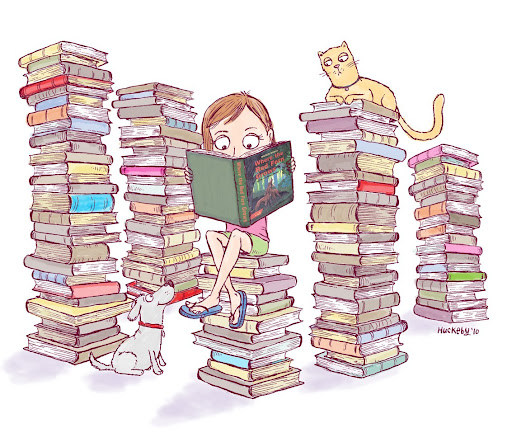
In 2025, 60% of adult Americans reported reading a book. However, the majority of those Americans did not finish more than ten books annually. Ms. Jacklyn Correa, a History and Special Education teacher, often reads up to three books a week, putting her in a unique category of just 4% of Americans who account for almost half of the books being read.
“I’m an avid reader, it’s my favorite pastime,” Ms. Correa says. “My mother was also a bookworm and she’s the one that instilled the love of reading in me at a young age.”
Ms. Correa enjoys reading books in the fantasy, historical fiction, sci-fi, and romance genres. She is neutral about non-fiction books and contemporary stories and hates self-help books. In terms of book length, Ms. Correa likes long “500-page plus books.”
“I tend to prefer female authors or stories with a female narrator or protagonist,” says Ms. Correa. “Some of my favorite authors are Mark Twain and John Steinbeck, but I also love Margaret Atwood and Sarah J. Maas.”
Not only is the material Ms Correa reads important, but also the environment she reads in is a big factor for her.
“I prefer absolute silence when I read and just being alone,” says Ms. Correa. “Reading is something that is intimate to me. I don’t like being disturbed as I’m reading and the story’s unfolding in my mind’s eye.”
Although Ms. Correa mostly enjoys books in private, she sees a social connection to reading as well.
“My closest friends are all readers,” says Ms. Correa. “We get to be fangirls together. Every year I go to Bookcon in the spring, an author/book convention in New York City. I’ve gotten to meet some of my favorite authors at that convention, and then I also follow several of my favorite authors on social media. So in that respect, reading has a social piece to me, but the act of reading is very intimate and personal.”
“I think you can tell a lot about a person’s character and personality by the books they read and the books they really love and connect with,” Ms. Correa says.
“I tend to judge people who don’t enjoy reading,” Ms. Correa admits. “[But] I’m not this elitist, you don’t have to read obscure Russian literature or anything like that, I don’t care what you read. If you’re an adult who doesn’t read, I do think a little less of you just because it’s something I love and value so much.”
Ms. Correa’s love of reading in youth is what propelled her success in school.
“I think my early exposure to reading helped me be successful in school despite being dyslexic, and it made me the learner I am today.”
Ms. Correa believes that reading not only helped her succeed in school but also can bolster HHS students’ academics.
“[Reading]’s absolutely necessary, I don’t think reading is an outdated skill. In my 18 years of teaching, I’ve seen reading decline among adolescents, and I’ve seen firsthand the negative impact it has had on students’ writing, spelling, vocabulary, imagination, and critical thinking.”
Marty West, academic dean and professor of Education at the Harvard Graduate School of Education, confirms the decline of reading, especially when it comes to reading for pleasure. He found that 27 percent of 13-year-old students read for fun in 2012, which fell to 13 percent in 2023. Within the same demographic those who “hardly ever read for fun on their own jumped from 22 percent to 31 percent over the same period” (Harvard Gazette).
Ms. Correa thinks that one solution is to encourage daily reading. “I’m not a huge fan of homework, but the one thing I would require all students to do, if I got to design the education model in America, would be daily required reading.”
“Your brain’s a muscle; reading is exercise,” says Ms. Correa. “You’re not going to love reading everything. Find whatever it is that’s your thing. Find the right author or genre or media print and read because not reading is definitely negatively impacting students’ other skills.”